





Feed Formulations
Feed Formulations
Feed formulations for broiler and layer chicken diets, based on the Nutrient Requirement of Poultry published by ICAR (2013).
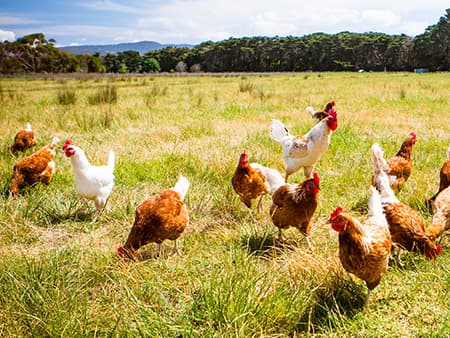
Broiler and Layer Chicken Diet
The broiler and layer diets are formulated based on Nutrient Requirement of Poultry published by ICAR (2013).
7 formulations across 2 categories
Broiler Chicken Diet
Commercial broilers are generally reared under two or three phases, viz. pre-starter phase (0-7/10 days of age), starter phase (7/10 -21 days of age) and finisher phase (21-35/42 days of age), to achieve 2 to 2.5 kg market body weight. The basic purpose of phasing out is to provide nutrients as per the need depending upon the growth rate and type of growth. Feed conversion ratio (FCR) is an important parameter in broiler production and the FCR values should be in the range of 1-1.1, 1.25-1.40 and 1.4 to 1.55 at 0.5 kg, 1kg and 2 kg body weights, respectively. Concentrations of amino acids, especially of limiting amino acids are important. The first, second and third limiting amino acids in the diets based on maize- soybean meal are methionine (or methionine plus cysteine), lysine and threonine. In the coming times, poultry has definitely to look beyond maize and soybean meal because of its availability; cost and also maize-soybean production cannot keep pace with the ever-increasing poultry production. So definitely there is a scope of alternate feed ingredients, which can be used partly to replace maize, are wheat, broken rice, pearl millet, sorghum, etc. Soybean meal is the conventional proteinic supplement in poultry diet, however, different proteinic by-products that can be used replacing soybean meal are groundnut oil meal, mustard or rapeseed meal, maize gluten meal, sunflower oil meal, etc. The meals of animal origin that were commonly used such as fish meal, meat meal, meat cum bone meal, etc. are used in negligible amount due to the availability of commercial synthetic amino acids.

Broiler Starter Diet


Broiler Finisher Diet


Broiler Concentrate Diet


Layer Chicken Diet
Layer chicken are generally reared in three phases viz. starter (0-8 weeks of age), grower (8-20 weeks of age) and layer (20 weeks or above). For meeting the nutrient requirement, particularly that of calcium at onset of lay, pre-lay phase (17/18 – 20 weeks) is recommended. The laying phase is often divided into phase I (20-30 weeks) and phase II (30-45 weeks) and phase III (> 45 weeks). Nutrition and feeding in early part of life influence subsequent laying performance. Modern layers attain sexual maturity (point of lay) at little earlier age (16 wk) as a result the birds produce 310-325 eggs per year. The critical nutrients required for optimum laying performance are energy and protein (amino acids). The energy concentration ranges from 2600 to 2850 kcal/kg during starting, 2500-2900 kcal per kg during growing and 2500 to 2800kcal/kg diet during laying phases. Similarly the requirements of protein for the corresponding phases are 18-20%, 15 to 16% and 15 to 18%. Birds can satisfy energy intake by adjusting their daily feed intake (100-110 g/d/b); however, they are unable to meet their amino acid needs by adjusting feed intake.
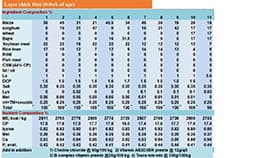
Layer Chick Diet


Layer Grower Diet


Layer Diet


Layer Concentrate Diet
